
Jump to a Section:
What Is Sound Healing? A Complete Guide to Sound Healing
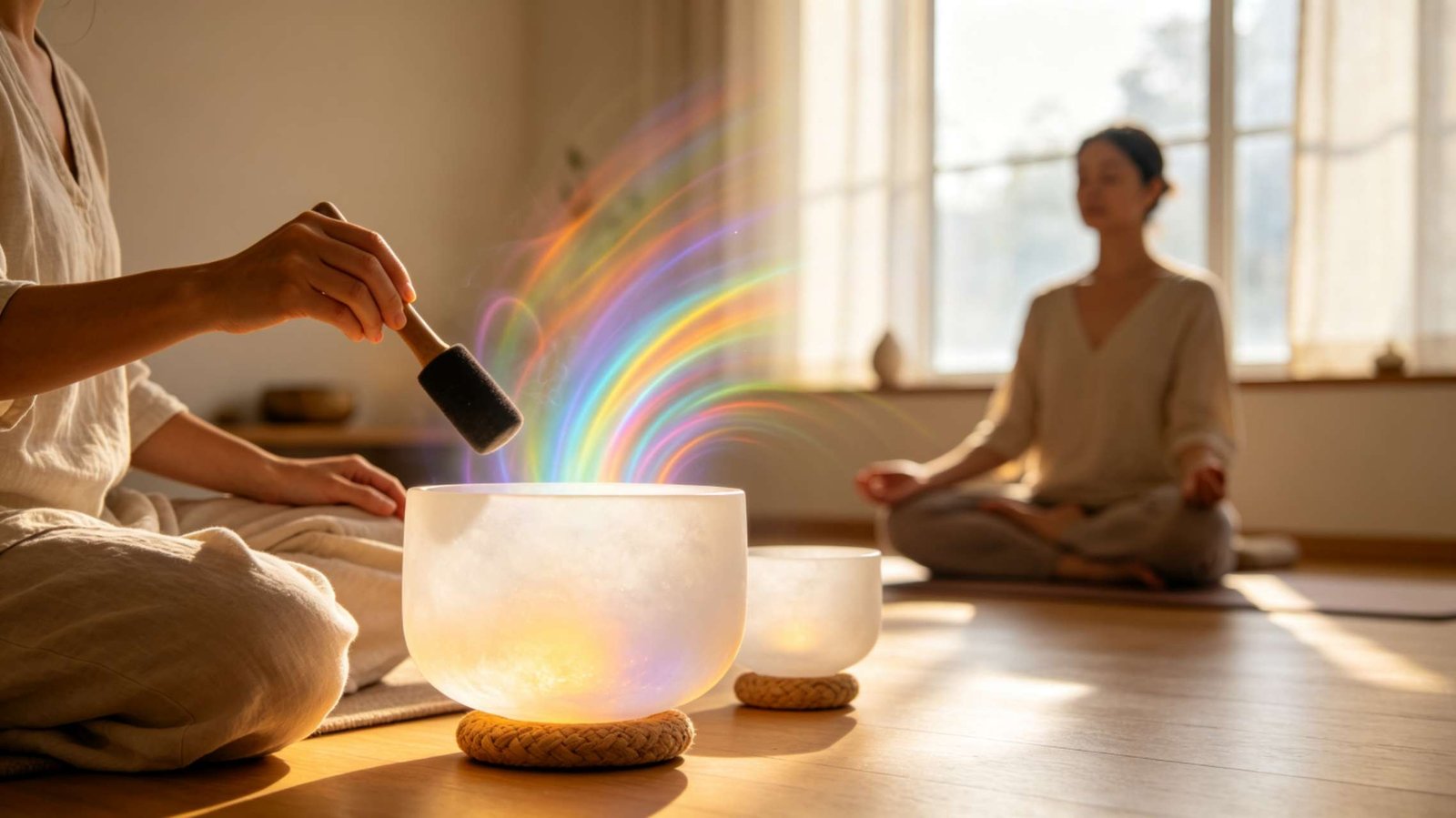
Have you ever felt a wave of calm wash over you when listening to ocean waves? Or felt your body relax when you hear the deep hum of a singing bowl? That gentle shift is exactly what sound healing works with — a non-invasive, vibrational practice that restores balance to your body, mind, and spirit. This complete guide to sound healing will walk you through everything you need to know.
Sound healing is an ancient practice that uses vibrational frequencies — from instruments like singing bowls, tuning forks, gongs, and even the human voice — to promote healing and relaxation. The core principle is simple: everything in the universe, including your body, is made of energy that vibrates at specific frequencies. When your body’s frequency falls out of harmony — due to stress, illness, or emotional trauma — sound can help restore balance.
This complete guide to sound healing covers everything from how sound healing works to the science behind it, the instruments used, and how you can use sound healing to reduce stress, improve sleep, and support emotional well-being.
Sound healing is not a new age trend. It is a practice rooted in ancient traditions from around the world — from the Tibetan singing bowls of the Himalayas to the Aboriginal didgeridoo of Australia, from the chanting of Hindu mantras to the use of music in ancient Greek healing temples.
Who Is Sound Healing For?
Sound healing is for everyone. Whether you’re a busy professional looking to unwind, a parent needing a moment of peace, or someone navigating anxiety, grief, or chronic pain — sound healing offers a gentle, accessible path to relief.
- Stressed professionals — seeking deep relaxation and mental clarity
- Anxiety sufferers — looking for natural, drug-free relief
- Meditation practitioners — wanting to deepen their practice
- Chronic pain patients — exploring complementary therapies
- Anyone curious — about energy healing and holistic wellness
How Does Sound Healing Work?
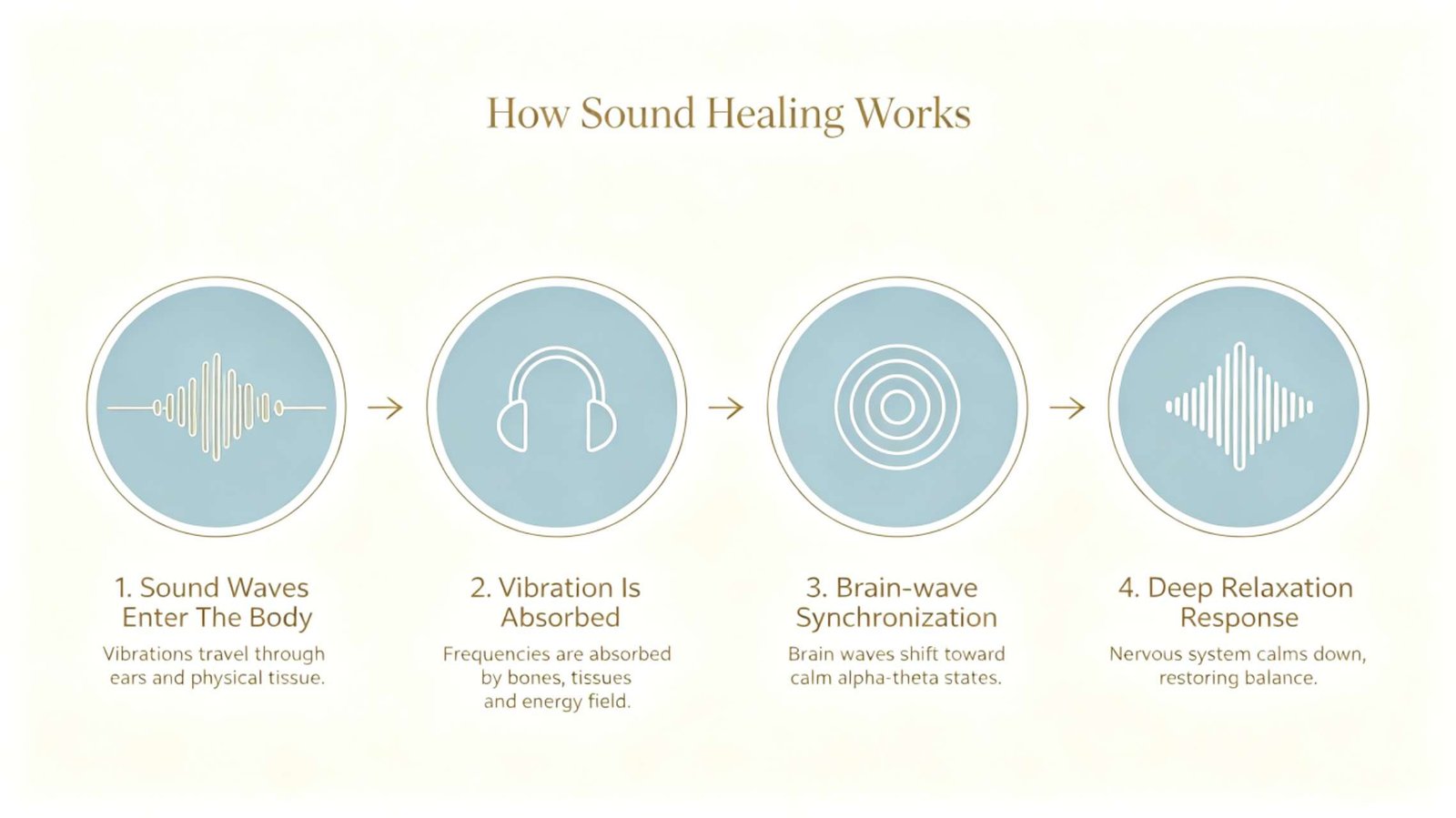
When sound enters your body, it doesn’t just stay in your ears. Sound waves travel through your entire body, reaching your cells, tissues, and organs. Every cell in your body has its own vibration. When you are healthy, these cells vibrate in harmony. But when you are stressed, sick, or emotionally imbalanced, your cells vibrate at a lower, less coherent frequency.
Sound healing works through a process called entrainment. This is a physics principle where two vibrating bodies will synchronize their rhythms over time. When your body is exposed to a stable, harmonious sound frequency, your brain waves and nervous system naturally synchronize to that frequency.
For example, when you listen to a singing bowl at 432Hz (a frequency often called the “natural tuning” of the universe), your brain waves begin to align with that frequency. If you are anxious, your brain waves are likely in the faster beta range. The soothing 432Hz sound helps your brain slow down into the more relaxed alpha or theta state — the same state associated with deep meditation and healing.
This is why sound healing feels so powerful — it bypasses the thinking mind and works directly on your nervous system and your body’s vibrational state.
The Science Behind Sound Healing
While sound healing has ancient roots, modern science is catching up. Researchers have documented the powerful effects of sound and vibration on the human body in numerous studies.
Key research findings include:
- Reduces stress hormones: A 2019 study published in the Journal of Evidence-Based Integrative Medicine found that participants who attended a 60-minute sound bath session experienced significant reductions in cortisol (the stress hormone) and improvements in mood.
- Improves brain wave patterns: Research using EEG (electroencephalogram) monitoring has shown that sound healing can shift brain waves from beta (alert/focused) to alpha (relaxed) and theta (deep meditation/creative) states. This shift is associated with reduced anxiety, deeper relaxation, and enhanced creativity.
- Supports pain management: A 2020 study in the Journal of Pain Research found that participants receiving vibroacoustic therapy (sound therapy delivered through specialized equipment) experienced significant reductions in chronic pain.
- Enhances immune function: Studies have shown that sound healing can increase the production of white blood cells, supporting the body’s natural defense system.
For more information on sound therapy research, visit the National Center for Complementary and Integrative Health (NCCIH) which provides evidence-based research on music and sound therapy.
📖 Explore the complete guide to Solfeggio frequencies →
Benefits of Sound Healing (Science-Backed)
Sound healing offers a wide range of benefits for physical, emotional, and spiritual well-being. Here are the most commonly reported benefits:
Physical Benefits
- Reduces stress and tension
- Lowers blood pressure
- Supports pain relief
- Improves sleep quality
- Boosts immune function
- Reduces chronic fatigue
Emotional Benefits
- Reduces anxiety and depression
- Promotes emotional release
- Enhances mood and well-being
- Increases mental clarity
- Deepens self-awareness
- Helps process trauma
Spiritual Benefits
- Deepens meditation practice
- Enhances intuition
- Creates sense of connection
- Supports spiritual growth
- Promotes inner peace
- Helps align with higher self
📖 Read the full guide to sound healing benefits →
Sound Healing Instruments: A Complete Guide
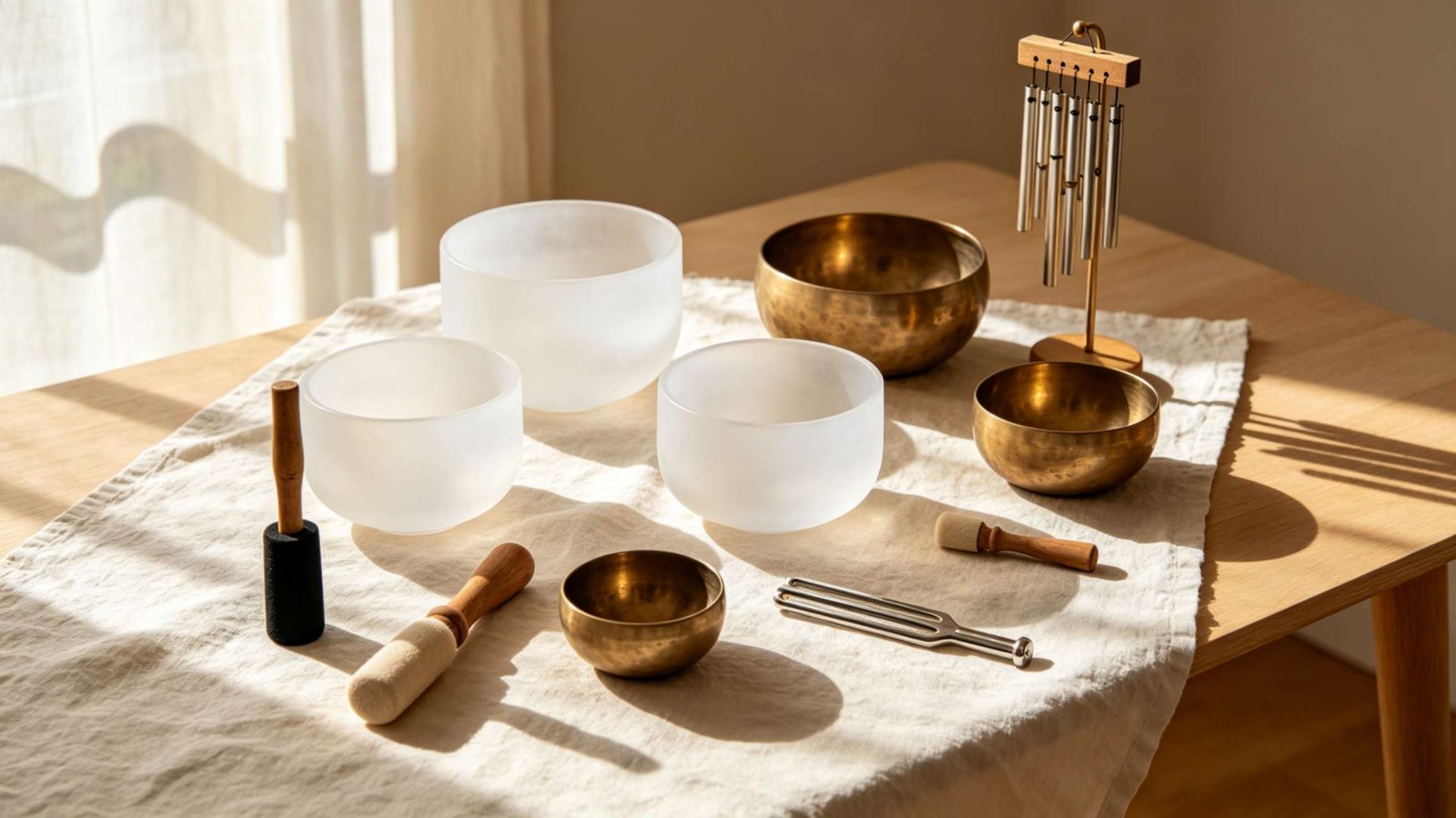
Sound healing can be practiced with a variety of instruments, each with its own unique frequency and healing properties.
Crystal Singing Bowls
Made from pure quartz crystal, these bowls produce a clear, pure tone. Each bowl is tuned to a specific frequency, often corresponding to the notes of the musical scale and the 7 chakras.
Tibetan Singing Bowls
Made from a combination of metals, these bowls produce a rich, complex sound with overtones. They are traditionally used in meditation and healing ceremonies in Nepal and Tibet.
Tuning Forks
Tuning forks are precise instruments that produce a single, pure frequency. They are often used for balancing the nervous system, releasing tension, and working on specific energy points in the body.
Gongs
Gongs produce a powerful, full-body vibration that can feel like a sound massage. They are often used in sound baths and group healing sessions.
Chimes
Wind chimes and bar chimes produce gentle, airy sounds that can promote emotional release and gentle relaxation.
Didgeridoo
An ancient Australian instrument, the didgeridoo produces a deep, resonant vibration that has been used for healing and spiritual ceremonies for thousands of years.
📖 Explore the complete guide to sound healing instruments →
Sound Healing and the 7 Chakras
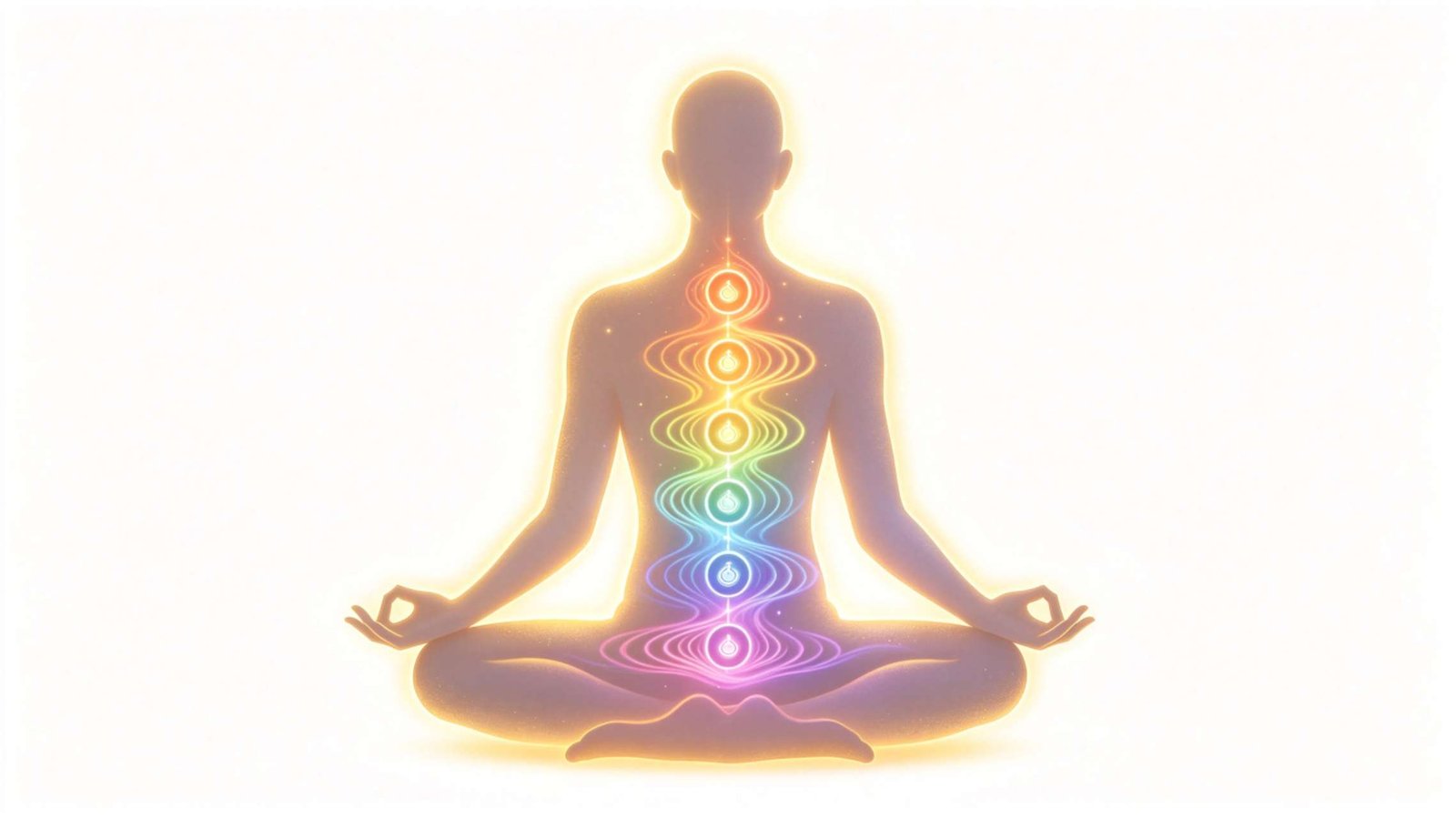
Each of the 7 chakras resonates with a specific frequency. When your chakras are balanced, energy flows freely through your body. When they are blocked, you may experience physical, emotional, or spiritual issues.
Sound healing can help clear and balance your chakras. Here is a quick reference:
| Chakra | Sound Frequency | Instrument |
|---|---|---|
| Root | 396Hz | Singing bowl, drum |
| Sacral | 417Hz | Singing bowl, tuning fork |
| Solar Plexus | 528Hz | Singing bowl, gong |
| Heart | 639Hz | Singing bowl, chimes |
| Throat | 741Hz | Singing bowl, tuning fork |
| Third Eye | 852Hz | Singing bowl, chimes |
| Crown | 963Hz | Singing bowl, silence |
📖 Explore the complete guide to Solfeggio frequencies →
Healing Frequencies: What They Do and How to Use Them
Different sound frequencies affect the body and mind in different ways. Here are the most commonly used healing frequencies and their effects:
432Hz — Natural Tuning
Often called the “natural frequency of the universe,” 432Hz is believed to promote relaxation, reduce stress, and create a sense of harmony and connection. Many sound healing practitioners consider this the optimal tuning for healing.
528Hz — The Miracle Tone
Known as the “love frequency” or “DNA repair frequency,” 528Hz is associated with transformation, miracles, and cellular healing. It is one of the core Solfeggio frequencies.
639Hz — Connection
This frequency is associated with relationships, emotional healing, and connection. It can help resolve conflicts, improve communication, and foster forgiveness.
852Hz — Awakening
Associated with the third eye chakra, 852Hz supports intuition, spiritual awakening, and insight. It is often used in meditation and spiritual practices.
📖 Explore the complete guide to 432Hz frequency benefits →
History of Sound Healing

Sound is one of the oldest healing modalities known to humanity. Archaeological evidence suggests that our ancestors used sound for healing as far back as 40,000 years ago.
- Ancient Greece: Pythagoras (c. 570-495 BCE) studied the healing effects of music and developed specific musical intervals that he believed promoted health and well-being. The Greek god Apollo was also associated with music and healing.
- Ancient Egypt: Egyptians used sound in their healing temples, often incorporating chanting and instruments into healing rituals. The healing temples of Imhotep used sound as a primary healing method.
- Indigenous traditions: Aboriginal Australians have used the didgeridoo for healing and spiritual ceremonies for over 40,000 years. Native American tribes use drumming, chanting, and singing in their healing ceremonies. Tibetan monks have used singing bowls for meditation and healing for centuries.
- India: The Vedic tradition (c. 1500-500 BCE) includes extensive use of mantra chanting (sacred sound) for healing and spiritual growth. The concept of Nada Yoga (yoga of sound) is a well-documented practice in ancient Indian texts.
Today, sound healing is experiencing a renaissance. Integrative medicine programs at institutions like Johns Hopkins and the Cleveland Clinic now incorporate sound healing, and sound baths are increasingly popular in wellness centers around the world.
Sound Healing for Anxiety: How It Helps
Anxiety is one of the most common reasons people turn to sound healing. And the science supports it — sound healing has been shown to produce immediate reductions in anxiety symptoms.
Why sound healing works for anxiety:
- Calms the nervous system: Sound healing activates the parasympathetic nervous system, shifting your body from “fight or flight” to “rest and digest.”
- Lowers cortisol: As mentioned earlier, sound healing has been shown to reduce cortisol levels, directly decreasing the biological markers of stress.
- Shifts brain waves: Sound healing helps slow brain waves from the fast beta state (associated with anxiety) to the calm alpha or theta state (associated with relaxation and meditation).
- Creates a sense of safety: The deep, grounding tones of singing bowls and gongs help your nervous system feel safe enough to let go of held tension.
- Breaks the stress cycle: Sound healing interrupts the cycle of anxious thoughts by giving your mind something to focus on (the sound) — similar to how meditation works.
📖 Read the full guide to sound healing for anxiety →
What Is a Sound Bath?
A sound bath is a group sound healing experience where participants lie down in a comfortable position while a practitioner plays instruments — typically singing bowls, gongs, and chimes — to create an immersive sound experience.
Unlike a music concert, a sound bath is not about listening to melodies. It’s about allowing the sound and vibration to wash over you, much like water in a bath. You simply relax, close your eyes, and let the sound do its work.
Sound baths have become increasingly popular in recent years because they offer a simple, accessible way to experience deep relaxation and stress relief. No experience is required — you just show up, lie down, and receive.
📖 Read the complete guide to sound baths →
How to Start Sound Healing
You don’t need expensive instruments to experience the benefits of sound healing. Here are three simple ways to start:
- Find a sound bath near you: Many wellness studios and yoga centers now offer sound baths. Use Google Maps or wellness apps like Mindbody to find one nearby.
- Listen to sound healing recordings: Many sound healing practitioners offer recordings on YouTube, Spotify, and wellness apps. Search for “singing bowl meditation” or “sound healing for relaxation.”
- Try self-sound healing: You can use your own voice. Chanting, humming, and vocal toning are powerful ways to use sound on yourself. Try humming a low note for 3-5 minutes and notice how you feel.
Frequently Asked Questions About Sound Healing
Can sound healing cure my condition?
Sound healing supports your body’s natural healing abilities. It should be used alongside, not as a replacement for, conventional medical care. Always consult your doctor for serious health concerns.
Do I need to believe in sound healing for it to work?
No. Sound and vibration affect your body whether you believe in it or not — just like gravity or electricity. The vibration of a singing bowl will still calm your nervous system regardless of your beliefs.
How often should I do sound healing?
It depends on your goals. Most people benefit from weekly sessions. Some people use sound healing daily as a meditation tool. Start with once a week and adjust based on how you feel.
Is sound healing safe?
Yes. Sound healing is non-invasive and has no known negative side effects. It is safe for pregnant women, children, and the elderly. However, if you have sound-sensitive conditions (like severe PTSD or epilepsy), consult your healthcare provider before attending a sound bath.
How long does a sound healing session last?
Most sound healing sessions last between 45 and 90 minutes. Sound baths are typically 60 minutes. Self-practice sessions can be as short as 5-10 minutes.
Can I do sound healing on myself?
Absolutely. Self-sound healing using your voice (chanting, humming, toning) is one of the most accessible ways to practice. You can also use singing bowls or tuning forks if you have them.
Is sound healing the same as music therapy?
No. Music therapy is a clinical practice led by trained professionals focused on achieving therapeutic goals. Sound healing is a broader, more holistic approach that uses vibration and frequency for relaxation and energy balancing.
References
- Journal of Evidence-Based Integrative Medicine. Effect of Sound Bath on Stress and Mood. 2019.
- Journal of Pain Research. Vibroacoustic Therapy for Chronic Pain Management. 2020.
- National Center for Complementary and Integrative Health (NCCIH). Music and Sound as Medicine. 2023. https://nccih.nih.gov/health/music
- Frontiers in Psychology. Sound Healing and Brain Wave Entrainment. 2021.
- International Journal of Yoga. Nada Yoga: The Yoga of Sound. 2020.
- Mayo Clinic. Complementary and Integrative Medicine: Music Therapy. 2023.
- Johns Hopkins Medicine. Sound Healing and Integrative Health. 2023.
- Journal of Alternative and Complementary Medicine. Biofield Therapies and Sound Healing. 2022.
- Salamon, E. et al. Nitric Oxide and the Auditory System. Medical Science Monitor. 2003.
- von Békésy, G. Similarities Between Hearing and Skin Sensations. Psychological Review. 1959.
- Thaut, M. Music Therapy in Rehabilitation. 2005.
About the Author

This complete guide to sound healing was written by our team of holistic wellness practitioners with over 10 years of experience in energy healing, sound therapy, and integrative wellness. We are committed to providing reliable, evidence-based information to help you on your healing journey.
Follow us for more sound healing guides and wellness tips.
Continue Your Sound Healing Journey
Disclaimer: Sound healing is a complementary therapy and should not replace professional medical advice, diagnosis, or treatment. Always consult your healthcare provider for medical concerns.
