
How to Become a Trauma-Informed Practitioner: A Complete Guide
If you’ve been searching for what is trauma-informed practice or wondering how to become a trauma-informed practitioner, this guide will walk you through the steps. Whether you are a coach, therapist, healer, or someone on a personal healing journey, this guide will walk you through what it means to become a trauma-informed practitioner, why it matters, and how to take the next step. If you’re looking for trauma-informed care training or a trauma-informed certification online, this is where to start.
Explore Practitioner Trainings →Watch the full class: How to Become a Trauma-Informed Practitioner — with Ryan Hassan and Matt Kay, co-creators of Embodied Processing at The Centre for Healing.
What Is Trauma-Informed Practice?
If you’ve been searching for what is trauma-informed practice or wondering how to become a trauma-informed practitioner, you’re not alone. Many coaches, therapists, and healers are looking for trauma-informed care training that goes beyond theory and equips them with practical, embodied skills.
Trauma-informed practice is often misunderstood. It is not a label you add to your website or a one-day training you tick off a list. True trauma-informed practice requires understanding how the nervous system adapts to threat, how traumatic imprints get stored in the body, and how to work with sensation rather than just talking about the story. This is the foundation of all somatic trauma healing training and trauma-informed practitioner training.
When you pursue trauma-informed care training, you learn to recognize the adaptive responses of the body — fight, flight, freeze, and fawn — and how these responses shape behaviour, relationships, and health. This is not about diagnosing or pathologizing. It is about understanding that trauma is not a disorder; it is an adaptation to overwhelming circumstances.
Becoming a trauma-informed practitioner means you can hold space for others without re-traumatizing them. You learn to recognize signs of dysregulation, offer grounding techniques, and create a container where healing can unfold naturally.
If you’re ready to take the next step, our trauma-informed practitioner training programs are designed to give you both the theoretical knowledge and practical skills you need.
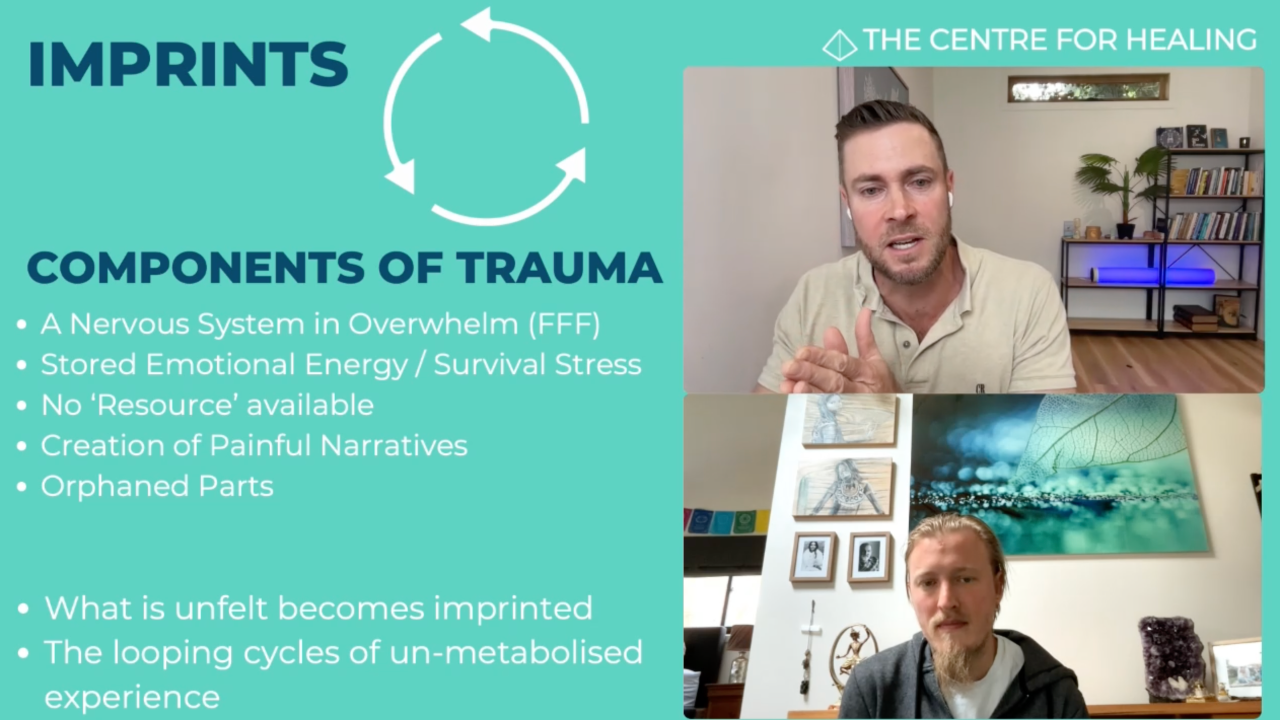
Watch the full class above — featuring Ryan Hassan and Matt Kay, co-creators of Embodied Processing at The Centre for Healing.
Why Trauma-Informed Practice Matters
When you’re working with clients (or on yourself), do you ever feel like there’s a missing piece of the puzzle? An underlying pain that drives self-sabotage, dysfunctional relationships, and coping mechanisms? This pain is where trauma-informed work begins.
Traditional approaches often focus on managing symptoms — changing thoughts, modifying behaviours, or offering coping strategies. While helpful, these approaches don’t always address the root cause. Trauma-informed practice goes deeper. It recognizes that symptoms are not the problem; they are the body’s adaptive responses to overwhelming experiences. This is why nervous system regulation training and somatic experiencing training are essential components of trauma healing courses for practitioners.
When you understand this, you stop asking “What’s wrong with you?” and start asking “What happened to you?” — and more importantly, “What is your body trying to tell you?”
Level 1: Foundational Awareness
Understand what trauma is, how it affects the nervous system, and why it manifests as chronic stress, anxiety, and relational difficulties. This is the first step in any trauma-informed care training or trauma-informed certification online.
Level 2: Nervous System Regulation
Learn to identify and regulate different nervous system states — from hyperarousal to dorsal shutdown — using practical, body-based techniques that form the core of effective nervous system regulation training and somatic trauma healing training.
Level 3: Somatic Practice
Master the skills of working with sensation, movement, and breath to release traumatic imprints stored in the body. This is where cognitive approaches fall short — and where somatic experiencing training and trauma-informed practitioner training make the difference.
Why Trauma Is Stored in the Body — and How Somatic Healing Works
Recent studies have shown that the effects of trauma are stored within the body. Trauma is not a disorder — it is an adaptation. Our nervous system adapts to feeling unsafe, and these adaptations get encoded in our tissues, posture, and physiological responses.
This is why cognitive approaches alone often fall short. You cannot think your way out of a nervous system response that is hardwired for survival. Working with the body — through techniques like somatic experiencing, nervous system regulation, and breathwork — allows you to address trauma at its source, not just manage its symptoms.
This is the foundation of trauma-informed practitioner training. You learn not only the theory but also the practical, clinical skills to guide clients through their own healing journeys.
The Centre for Healing offers internationally accredited trauma-informed certifications that are recognized worldwide.
How to Become a Trauma-Informed Practitioner in 3 Steps
Follow this proven pathway to build your skills, gain certification, and start helping clients heal.
Educate Yourself
Start by understanding the fundamentals — what trauma is, how it affects the nervous system, and what safety looks like in a therapeutic container. This is the foundation of any trauma-informed certification online.
Develop Practical Skills
Learn body-based techniques for regulation, grounding, and working with sensation. Nervous system regulation training and somatic trauma healing training are essential components of becoming a skilled practitioner.
Get Certified & Start Practicing
Pursue a structured trauma-informed practitioner training program that offers certification, mentorship, and a community of practice. Look for trauma healing courses for practitioners that are internationally recognized.
How to become a trauma-informed practitioner with The Centre for Healing certification programs
What Practitioners Are Saying
“Such amazing people operating this company. You can literally FEEL their passion for what they do. Root-Cause Therapy is such a powerful tool.”
“Embodied Processing is a powerful modality which I can’t wait to support clients with. The depth of knowledge and understanding of trauma delivered by the team brought next level insights.”
“Learning this modality has completely changed my life both personally and in the way in which I work with and achieve results with my clients.”
“Changed my life! RCT has changed my understanding human psychology and behaviour. It helped me understand why we are the way we are.”

The Centre for Healing founders Melissa and Ryan sharing their journey
Learn From People Who’ve Been There
Doing what you love for a living.
Understanding trauma and how to work with these imprints, along with the knowledge of how to run a healing practice, will put you well on the way to your dreams. This is the essence of trauma-informed practitioner training — learning from those who have walked the path before you.
TCFH Founders Melissa & Ryan started with no clients, no referrals, no credibility & no money — and built a million-dollar healing business in just a few years. Now they teach what they’ve learned. Their journey is a testament to what trauma healing courses for practitioners can achieve when backed by genuine lived experience.
There are too many great therapists not making the living they deserve — it’s time for you to be one that does. Start your trauma-informed care training journey today.

Teaching from the heart — lived experience in trauma-informed practice
Teaching From The Heart.
The trainings & courses aren’t just taught from a text book — they are taught from lived experience. This is what sets trauma-informed practitioner training apart from traditional academic programs.
Along with nervous system theory, neuroscience & study citations, you’ll receive stories of trauma, addiction & mental illness. The TCFH Team has been there, and now are dedicated to giving back. Their somatic trauma healing training is grounded in real-world application, not just theory.
Many students comment on the ‘No BS’ approach which we believe is so important in delivering content in a relatable way. This is trauma-informed care training that actually prepares you for the reality of client work.
The Ultimate Trauma Therapy Checklist
11 Steps to Client Success — Get it for FREE Now!
Download the Checklist for FREE →
Ready to Become a Trauma-Informed Practitioner?
Explore our full range of trauma-informed practitioner trainings and certifications — including Root Cause Therapy (RCT), Embodied Processing (EP), and The Somatic Practitioner Bundle. All programs are designed to give you the practical skills and theoretical grounding you need to confidently support clients. Whether you’re seeking trauma-informed certification online or want to deepen your existing practice, find the right trauma-informed care training for your journey.
Browse All Trainings →Frequently Asked Questions About Becoming a Trauma-Informed Practitioner
What is a trauma-informed practitioner?
A trauma-informed practitioner is a professional who understands how trauma affects the nervous system and body, and who uses this understanding to create safe, supportive environments for healing. They work with sensation, regulation, and relationship — not just cognitive processing. This is the core of trauma-informed practice.
What is the best trauma-informed certification online?
The best trauma-informed certification online depends on your goals. Look for programs that offer practical skills, mentorship, community support, and internationally recognized accreditation. Programs like Root Cause Therapy (RCT) Certification and Embodied Processing (EP) Certification are highly regarded for their depth and practical application. These trauma healing courses for practitioners combine theory with embodied practice.
How is trauma-informed practice different from traditional coaching or therapy?
Traditional coaching and some therapeutic models focus primarily on cognitive processes — thoughts, beliefs, and behaviors. Trauma-informed practice recognizes that trauma is stored in the body and nervous system, not just the mind. It works with sensation, breath, movement, and nervous system states to address the root cause of symptoms. This is why somatic trauma healing training is so effective.
Can I become a trauma-informed practitioner without prior experience?
Yes. Many trauma-informed practitioner trainings are designed for beginners. You will learn foundational concepts and practical skills progressively. No prior experience is required — just a willingness to learn and a passion for helping others. This is the beauty of trauma-informed care training — it meets you where you are.
How do I choose the right trauma-informed practitioner training?
Choosing the right training depends on your goals, experience level, and preferred learning style. Look for programs that offer practical skills, mentorship, community support, and internationally recognized certification. Explore our trauma-informed practitioner trainings to find the right fit for your trauma-informed certification online journey.
Is trauma-informed practitioner training internationally recognized?
Yes. Leading trauma-informed practitioner training programs are internationally accredited. Certifications from The Centre for Healing are recognized by IICT, IOATH, and ICAHP. Many students also earn CPD/CEU credits applicable to their existing professional memberships. This ensures your trauma-informed care training carries weight wherever you practice.