

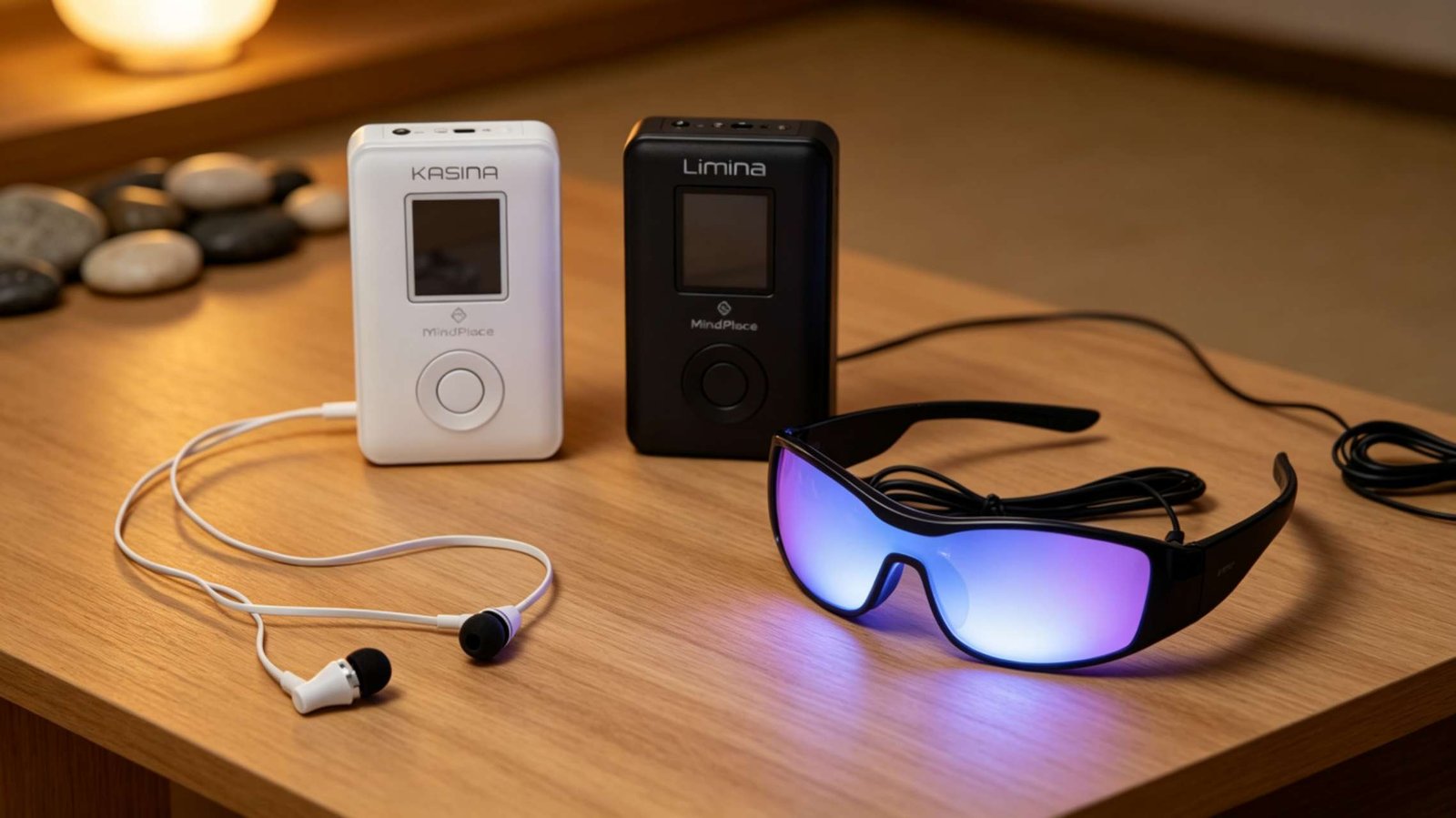
If you’ve been researching AVS (Audio-Visual Stimulation) devices — sometimes called light and sound machines or brainwave entrainment devices — you’ve probably come across MindPlace’s two most popular models: the Limina and the Kasina. Both come from the same manufacturer and share nearly identical core engines, but they differ in storage, power, and expandability in ways that matter a lot depending on how you plan to use one.
This guide won’t just dump a spec sheet on you. We’ll first walk through how these devices actually work, then map the Limina vs Kasina differences onto that framework, and finish with a simple method you can use to make the call yourself — rather than just taking someone else’s word for which one is “better.”
How AVS Devices Actually Work
Before comparing specs, it’s worth explaining the underlying mechanism, since most comparison articles skip straight to the numbers without explaining what they mean in practice.
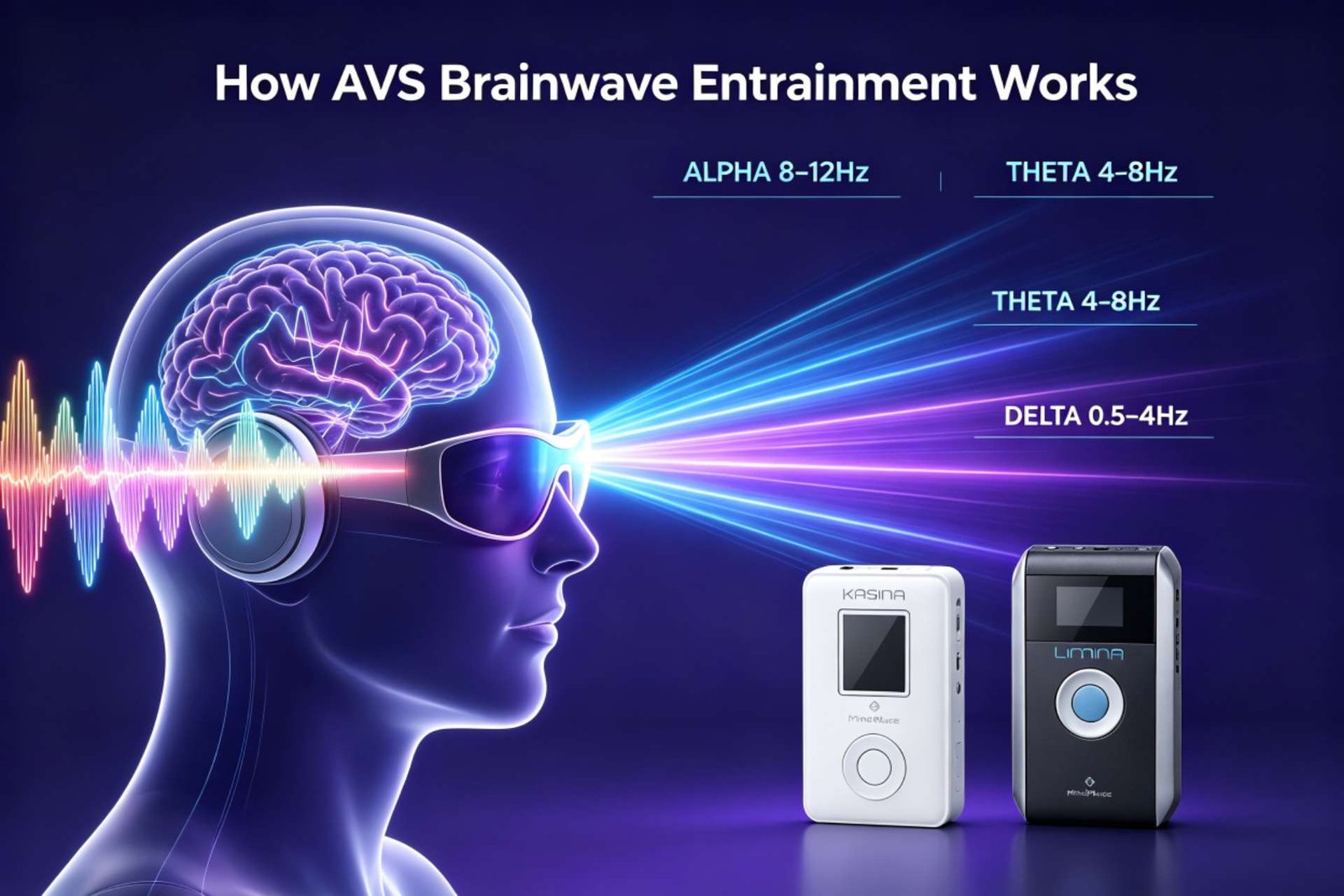
AVS (Audio-Visual Stimulation) works by delivering rhythmic light pulses (usually through LED glasses) and synchronized sound to the user, based on the idea that brain activity tends to shift toward the frequency of an external rhythmic stimulus — a phenomenon researchers call the frequency-following response. Most brainwave entrainment devices, including both the Limina and Kasina, are built around this concept, targeting specific frequency bands:
- Delta (0.5–4 Hz) — commonly associated with deep sleep states
- Theta (4–8 Hz) — commonly associated with meditation, relaxation, and light sleep
- Alpha (8–13 Hz) — commonly associated with relaxed alertness
- Beta (13–30 Hz) — commonly associated with focus and active alertness
It’s worth being upfront here: the frequency-following response has a documented physiological basis, particularly in how the visual cortex responds to flickering light. However, whether light and sound stimulation reliably shifts a user into a specific brainwave state — and produces a corresponding subjective experience — isn’t something researchers consider firmly settled, and individual responses vary quite a bit. So when this article talks about “experience” later on, it uses language like “many users report” rather than presenting outcomes as guaranteed. That caveat applies equally to both devices — it’s a baseline fact about this product category, not a knock against either one.
Within that framework, there are three specific techniques worth understanding before you compare specs:
- Binaural Beats — Two slightly different tones are played separately into each ear (say, 200 Hz in the left ear, 210 Hz in the right). The brain perceives a “beat” equal to the difference between the two (10 Hz, landing in the Alpha range) — a beat that doesn’t actually exist in either audio channel on its own, but emerges from how the brain integrates the two signals. This only works with stereo headphones; you won’t perceive binaural beats through external speakers.
- Isochronic Tones — Unlike binaural beats, isochronic tones are a single tone pulsed on and off at the target frequency itself — no need for separate left/right channels, and no headphones required. Some users find isochronic tones more immediately noticeable than binaural beats, likely because the rhythm is delivered directly rather than perceptually constructed.
- AudioStrobe / SpectraStrobe — This is MindPlace’s core synchronization technology: control signals for the LED glasses are encoded directly into an audio file’s channels, so the glasses flash in sync with the audio as it plays. AudioStrobe is the older standard with simpler channel control; SpectraStrobe is the newer standard, supporting finer multi-channel RGB control — a distinction that matters directly for the Limina vs Kasina comparison below.
With that groundwork in place, terms like “binaural beats support,” “isochronic tones,” and “SpectraStrobe channels” in the spec tables below should mean something concrete rather than just marketing checkboxes.
About MindPlace
MindPlace was founded in 1988 and is one of the longest-running manufacturers in the AVS device space. Its product line has evolved from the Sirius and Proteus through the Procyon, with the Limina and Kasina as the current flagship pair. The brand’s reputation is generally built on solid hardware engineering and a large library of preset sessions — reputation that reflects build quality and usability, not a scientific endorsement of entrainment effects, which is worth keeping in mind while shopping.
MindPlace Limina Review
The Limina is positioned as the modern successor to the Procyon, aimed squarely at value-conscious buyers. Its core engine is nearly identical to the Kasina’s: it supports both AudioStrobe and SpectraStrobe decoding, 6-channel color control, 255 grayscale levels per channel, a 0.1–1000 Hz frequency range, and both binaural beats and isochronic tones. In other words, none of the three techniques covered above are missing — which is exactly why the Limina can offer a near-flagship experience at a lower price.
The storage design is the key thing to understand about the Limina. Sessions live only in internal flash memory, and only in MindPlace’s proprietary KBS format. The 104 built-in sessions cover most common goals — relaxation, focus, sleep — and the free KBS session editor lets you fine-tune frequency curves and color schemes yourself. The tradeoff: you can’t load your own white noise or guided meditation audio directly onto the device. External audio can only be played live through the 3.5mm AUX input, not stored on the unit.
- ✅ Pros
- $299 official price — the more affordable of the two
- Core AVS engine essentially matches the Kasina
- Supports both AudioStrobe and SpectraStrobe decoding
- Supports Ganzfeld (full-field visual immersion) sessions
- Free KBS session editor included
- ❌ Cons
- No internal battery — runs on 2 AA batteries
- No mp3/wav playback — can’t load external audio
- Windows-only compatibility for session editing
MindPlace Kasina Review
The Kasina is MindPlace’s flagship, built around full functionality and expandability. It replaces internal flash storage with a microSD card (16GB included, expandable) and adds a built-in mp3/wav player — meaning you can load your own meditation audio, white noise, or any personal audio files directly onto the device. This isn’t a firmware limitation on the Limina’s part; it’s a structural hardware difference in how each device stores content.
The Kasina’s 6-channel independent RGB control via SpectraStrobe is worth calling out specifically. As explained above, SpectraStrobe’s core value is finer color control, and the Kasina takes that further by letting each RGB channel be adjusted independently — in theory enabling richer color gradients and visual layering than the Limina. Note this mainly affects visual refinement, not the strength of the frequency-following response itself — worth keeping those two things separate when comparing.
- ✅ Pros
- 6-channel independent RGB control via SpectraStrobe
- Built-in rechargeable lithium battery, USB charging
- Color LCD screen for intuitive navigation
- Built-in mp3/wav player + microSD expansion
- Works with both Windows and Mac
- ❌ Cons
- $399 official price — about 30% more than the Limina
- Glasses are relatively delicate
- Steeper learning curve for first-time users
MindPlace Limina vs Kasina: Full Spec Comparison
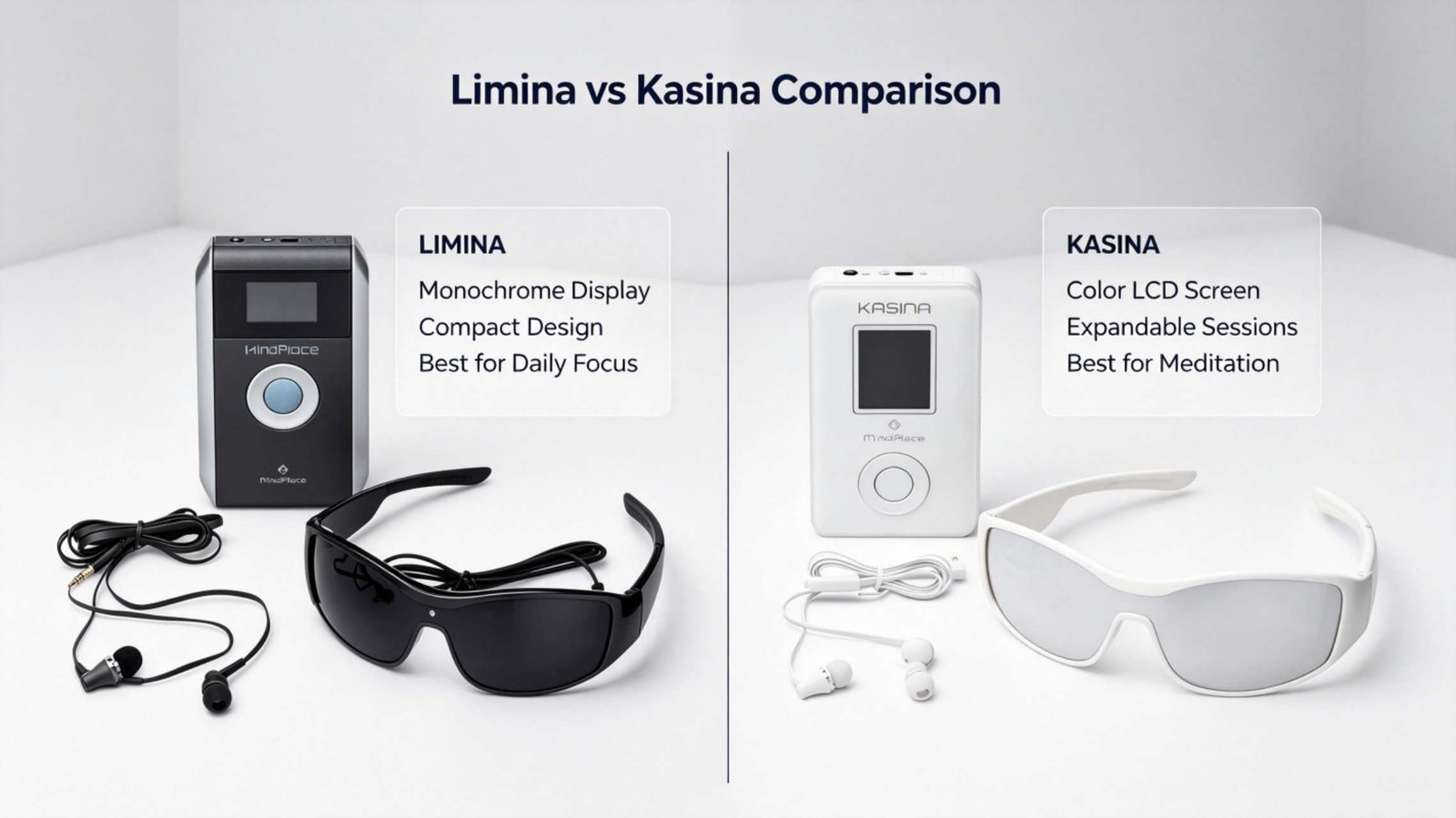
| Feature | Limina | Kasina |
|---|---|---|
| Official price | $299 | $399 |
| Session storage | Internal flash (KBS only) | microSD card (expandable, supports mp3/wav) |
| Built-in presets | 104 (KBS only) | 46 (KBS, AS, SS, CO formats) |
| Power | 2 AA batteries | Built-in rechargeable lithium, USB charging |
| Built-in mp3/wav player | No | Yes |
| Display | Monochrome LCD | Color LCD |
| SpectraStrobe channels | Supported | Supported, 6-channel independent RGB |
| Computer compatibility | Windows only | Windows + Mac |
| Free session editor | Yes (KBS only) | Yes (KBS/AS/SS) |
| AudioStrobe decoding | Yes | Yes |
| Ganzfeld support | Yes | Yes |
| Binaural beats / isochronic tones | Both supported | Both supported |
| Frequency range | 0.1–1000 Hz | 0.1–1000 Hz |
How to Use an AVS Device (Applies to Both)
Regardless of which device you choose, the usage logic is the same — understand this once and it transfers to either machine:
- Pick your target frequency band first. For relaxation or sleep, look for Theta or Delta-range sessions. For focus, look for higher Alpha or Beta-range sessions.
- Wear the glasses with your eyes closed. Ganzfeld visual stimulation is perceived through closed eyelids; using the device with eyes open produces a completely different (and generally less immersive) experience.
- Use headphones for binaural beats. As explained above, binaural beats require separate left/right channels — external speakers won’t produce the effect. Isochronic tones work either way.
- Start with shorter sessions. Most presets run 15–30 minutes; it’s not advisable to jump straight into an extended session before you know how your body and eyes respond.
- Track your own subjective response rather than expecting a guaranteed effect. Because individual responses vary, it’s worth logging how you feel after each session to figure out which frequency bands and presets actually work for you, rather than assuming someone else’s experience will match yours.
A Better Way to Compare: Three Filtering Questions
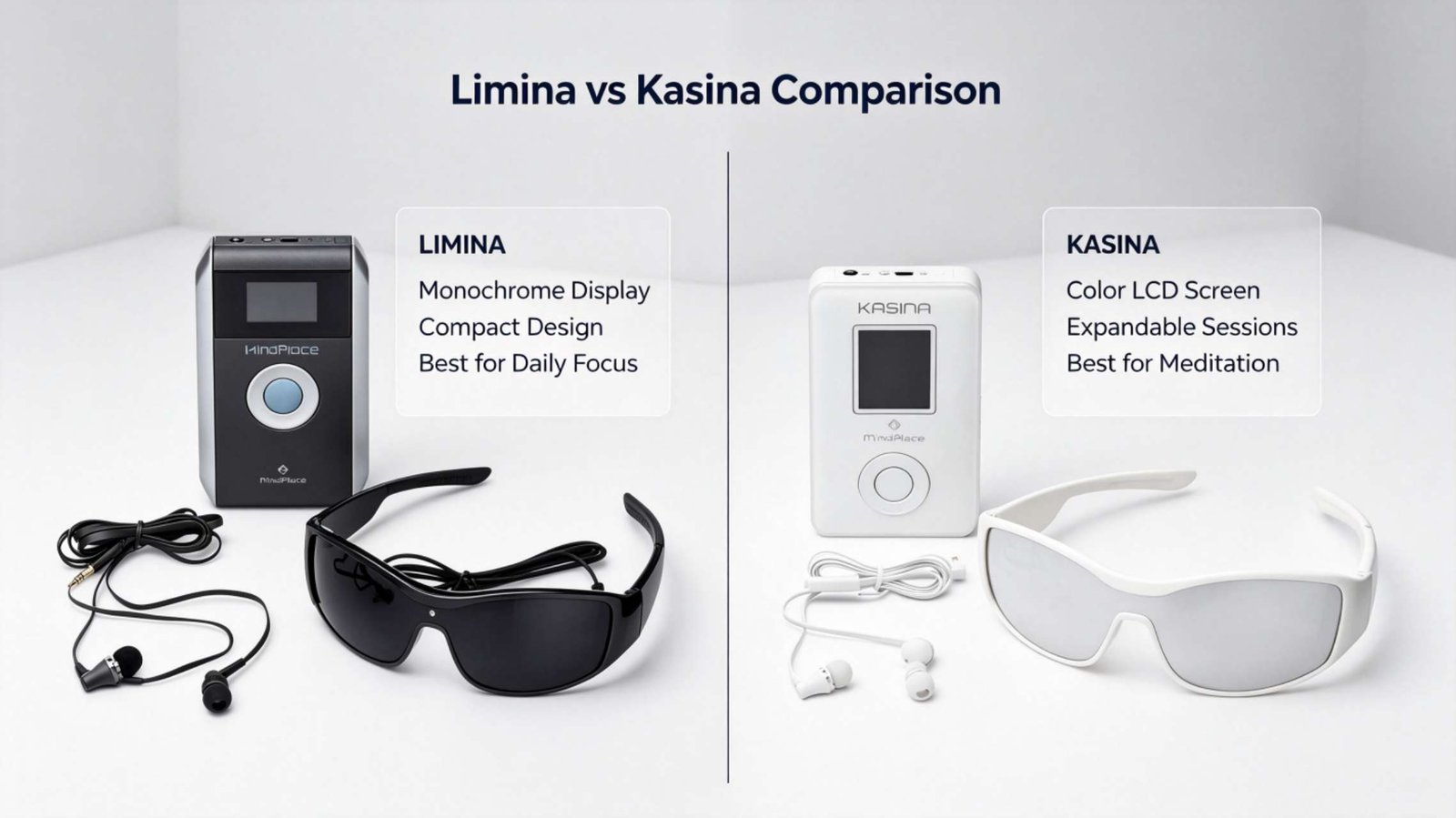
Rather than staring at a full spec sheet, it’s more useful to run any AVS comparison through three questions in order:
- Is the core stimulation engine actually different? If frequency range, channel count, and binaural/isochronic support are essentially equal (as they are here), the “ceiling” on stimulation capability is the same — you can move past this question quickly.
- Does the content workflow match how you’ll actually use it? Sticking to official presets, or loading your own audio? This single question determines whether internal flash storage (Limina) or SD card + built-in player (Kasina) fits your habits.
- How much does day-to-day convenience matter to you? Power source, screen quality, and cross-platform support don’t change the stimulation itself, but they affect how pleasant the device is to live with long-term — worth paying extra for if your budget allows.
Real-World Use Cases
The Limina fits well for buyers on a tighter budget who want a lighter-weight setup — think occasional travel use, being fine with AA batteries as backup power, or simply wanting to try AVS technology without a large upfront investment. Its 104 built-in presets are more than enough for most newcomers to get started.
The Kasina fits better for people planning to make AVS sessions a long-term habit. The built-in player and SD card expansion mean you’re not limited to official presets — you can bring in your own guided meditations, white noise, or ambient audio — and the color screen makes switching sessions and adjusting parameters more intuitive day to day.
Worth repeating: specific subjective effects vary from person to person. Treat any description of “experience” here as commonly reported rather than guaranteed.
Which One Should You Buy?
✅ Choose the Limina if you:
- Care more about value and don’t want to spend up to $399
- Are fine using only the official KBS preset library
- Primarily use a Windows PC for session editing
- Don’t mind using AA batteries for power
- Want to try AVS technology before committing long-term
✅ Choose the Kasina if you:
- Plan to use an AVS device regularly and long-term
- Want to load your own mp3/wav audio or white noise
- Use a Mac and need cross-platform compatibility
- Value the color screen and finer SpectraStrobe control
- Don’t mind paying about 30% more for greater expandability
Final Verdict
In short: the Limina is the better-value, lighter-weight entry point, while the Kasina is the more expandable, full-featured flagship. The two are nearly identical on the core AVS engine — frequency range, channel count, grayscale depth, binaural beats, and isochronic tone support — so the real dividing line comes down to storage flexibility, power source, and cross-platform support. Which one makes sense for you ultimately depends on your budget and whether you want long-term, deeply customizable use.
Frequently Asked Questions
No. The Limina only reads MindPlace’s proprietary KBS session format and has no built-in mp3/wav playback — this is one of the Kasina’s clearest advantages.
AudioStrobe is an older audio-visual sync standard with simpler channel control. SpectraStrobe is the newer standard and supports independent multi-channel RGB control (6 channels on the Kasina), enabling richer color variation.
If you’re not sure you’ll stick with AVS long-term, the Limina’s lower price and ample preset library make it a lower-risk starting point. If you’ve already decided to commit long-term, the Kasina’s expandability tends to pay off.
Both support 3.5mm AUX audio input. Whether you specifically need headphones depends on which technique you’re using — binaural beats require stereo headphones to work at all, while isochronic tones work through speakers too. Check the manual for the manufacturer’s recommended setup.
KBS is MindPlace’s proprietary session file format, containing preset light and sound synchronization parameters. Users can also create or edit KBS sessions using the free official editor.
Neither is objectively stronger — they’re just different delivery mechanisms. Binaural beats are a beat perceived by the brain from two slightly different tones (headphones required); isochronic tones are a directly pulsed rhythm (headphones optional). Some users find isochronic tones more immediately noticeable, but this is subjective and worth testing for yourself.
The frequency-following response — the brain’s activity shifting in response to external light/sound rhythms — has some physiological basis. Whether that reliably produces specific subjective states (relaxation, focus, etc.) isn’t something researchers consider firmly settled, and results vary by individual. It’s reasonable to try these devices as a relaxation or focus aid, but not to expect guaranteed outcomes.
Ganzfeld refers to a full-field visual effect experienced with eyes closed, where light from the glasses fills the entire visual field through the eyelids, producing a boundary-less, flowing sense of color. This effect specifically requires closed eyes — using the glasses open-eyed produces a very different experience.
This article is based on MindPlace’s official published specifications. Pricing and specs are subject to change — check the official MindPlace site for current details before purchasing. Some links on this page are affiliate links; we may earn a small commission at no extra cost to you.
